skip to main |
skip to sidebar
 It looks like Starbucks is quietly bucking the star, at least on this site.
Rumoured to be a possible testing ground for a new model of coffee shop, the site has a more authentic, localised feel with coffee blended and roasted in small batches and pastries sourced fresh from a local bakery.
The name for the new site: 15th Avenue Coffee & Tea
Given Starbuck's softening performance over the last two years, this could be the beginning of a new face, brand or experience for Starbucks. Such is the connection with the brand (in love or loathing)that it has appeared in major news and is inciting considerable commentary amongst specialists and social media alike.

It is difficult to know where to begin, when you begin to think of innovation.
There is no common definition - one person's innovation is another person's logical line extension.
If they noticed the new product at all (think many new car launches).
Perhaps innovation should be defined by users? It has been stated that innovation is one of the strongest levers to change customer behaviour, and to generate profit. If customers don't change, is it not innovation? Or just not relevant? Does innovation by its very nature have to be relevant? For example, would a car that changed colour when in use be an innovation?
There is a new product failure rate (variably) quoted as 50-90%, with companies spending enormous amounts of money and time investing in 'innovation' at all ends of the spectrum.
Recently it seems there is an (arguable) decline in the rate of innovation in consumer goods, based on my experience and touched upon here. Is this a symptom of the financial downturn or are many organisations realising there is a problem, stopping the wastage but then not knowing how to progress?
Or is it innovation exhaustion - people, companies and industries that have been running so hard for so long with such low success rates and high levels of corporate pressure (and risk aversion - see an antidote from Neil Perkins), that it has become all too much for us all.
So we have decided that for now, we need a little lie down?
Some great examples of some (product) companies refusing to lie low are Help, Slow cow and Sipahh
I have a feeling that this is just a power-nap and the next phase will be when consumer good companies start to 'get' genuinely consumer led innovation.
Flickr photo credit: out_of_rhythm
glimpsing away from the navel for a second...came across these. cute funny.
Blamestorming: Sitting around in a group discussing why a deadline was missed or a project failed, and who was responsible.
Seagull Manager: A manager who flies in, makes a lot of noise, and then leaves.
Cube Farm: An office filled with cubicles.
Stress Puppy: A person who seems to thrive on being stressed out and whiny.
Treeware: Hacker slang for documentation or other printed material.
Alpha Geek: The most knowledgeable, technically proficient person in an office or work group. "Ask Larry, he's the Alpha Geek around here.
Percussive Maintenance: The fine art of attacking an electronic device to get it to work again.
Thinking about a bit of percussive maintenance on my always too slow internet dongle...
 It feels like there is a hyerbabble of noise around marketing and social media...so much so that I wonder how much is noise and how much is actually just common sense?
Why are people scurrying to have a presence in the latest social medium, forums and events? Is it to have a voice, to enable customers to talk to you, to be cool?
Is this about being cool, or just common sense that you need to enable customers to speak with you and tell you what they want?
And all this talk of authenticity, firms trying to act with and create that sense of authenticity, trying to make sure each and every touch point is authentic. Perhaps if they just focused on what they wanted and needed to do, and focused on doing it well...I guess that would be pretty authentic!
Authenticity is about doing what you say you will, being what you say you are, and interacting in an honest way with people. It really should be pretty straight forward. Although it may not always be that easy when enmeshed in a history of organisational systems, products, processes and politics.
Common sense doesn't have to just mean using logical (and proven) tactics and offerings in the market, it can be just as sensible to offer something extraordinarily different in the market. This means that you have less direct competition, more efficient marketing spend and increased opportunities for sustained brand differentiation and growth. It is also common sense to understand where you customers are going, understanding their evolving needs, particularly in a culture-shifting moment such as the current GFC, as highlighted by Trendwatching.com.
To me, it is common sense that when you deliver what people want, with honest conversation about what they want, customers will be happy, and your business will grow. And if you find new tools to do that better, be it social media or not, it is common sense to use them too.
Flickr photo credit: goodbyebyesunday's

Today I stumbled across many examples of crowdsourcing. In one case, crowd-sourcing patient data for tracking disease and health state information, to crowd-sourcing scientific data and Nike crowd-sourcing running information.
All amazing examples of using the power of the collective. Fundamentally super-charged by technology, enabling access, connection, storage, tracking and distillation - to either the macro or the micro. You can see that the global average running time is 35 minutes and that people in America run shorter distances, more often. If you included Nike+ mapping you could take it to the favourite running tracks in your neighbourhood.
So - this acts on the fundamental lever of engagement and kicks off the Hawthorne Effect - what gets measured (observed) gets done.
What are you trying to change - are you trying to improve heart health, encourage people to make the healthier choice in breakfast cereals (which just might be yours)? How can you enable and engage people, harnessing their collective information to help them? Would it be that hard to set up a national wine drinking poll or a national dietary register...? The learnings could work to shape an entire country's behaviours to a healthier way of life.
All by enabling one person at a time to simply track their behaviour.
It may not be perfect (i.e. Wikipedia)...but it can be an enormous step in the right direction.
Flickr photocredit: Geoff Penn

Reading a fantastic article about Trust in Business led to thoughts of brand authenticity. Is brand authenticity interchangeable for trust in a brand?
Brand authenticity can be defined as the degree to which the beliefs, values, communications and actions of an organisation are aligned. And continue to be so over time.
The most direct way that customers experience this is - do you act as you say you will?
According to Green, reliability, or doing what you say you will, is only part of the equation in creating trust. There are also the variables described as Credibility, Reliability, Intimacy, and Self-Orientation. It is suggested they inter-relate to create an overall level of trust as per the equation show.
The Trust Equation

Green explains each of the other variables:
Credibility has to do with the words we speak. In a sentence, we might say, “I can trust what she says about intellectual property; she is very credible on the subject.
Intimacy refers to the safety or security that we feel when entrusting someone with something. We might say, “I can trust her with that information; she’s never violated my confidentiality before, and she would never embarrass me.”
Self-orientation refers to the focus of the person in question. In particular, whether the person’s focus is primarily on himself or herself or on the other person. We might say, “I can’t trust him on this deal—I don’t think he cares enough about me, he’s focused on what he gets out of the deal.” Or—more commonly—“I don’t trust him—I think he was too concerned about how he was appearing, so he wasn’t really paying attention."
The most powerful variable is self-orientation, which has a negative impact on trust levels.This is most commonly gauged by how much someone feels they are being listened to. Or not.
Creating trust requires authenticity in what is said (credibility) and what is done (reliability). Adding in the additional variables of intimacy (= brand connection / emotional branding in brand speak) and self-orientation (= the level of customer-orientation, client centricity in brand speak) is a deeper way of understanding the relationship with customers, with the resultant feeling of trust I would suggest coming closer to the notion of brand loyalty (discounting habital purchases).
Authenticity does not = trust, but trust requires authenticity.
Some brands that have done this well include Zappos, Google and Apple. They are extremely customer-led, with true customer dialogue and have a degree of transparency in the their values, beliefs and actions.
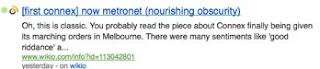
A perfect example of the opposite is a company that operated much of Melbourne's transit system - Connex. Disliked intensely by the community due to their unreliability, lack of credibility and aparent lack of listening (a recent spokesperson recently blamed Australian culture for their tardy record!), they did not have the contract renewed to much community celebration. A snippet found in Social mention shown below.
A final point to note from Green's article is that ultimately people trust people, not organisations. It is their experience of an organisation's people that informs that trust.
How do your people evidence each of the trust parameters? Is there something that can be done to improve this, even if it is asking a simple question in every conversation - why?
 I had the pleasure of meeting a very interesting, very understated expert marketer today.
Not only is he a gem of a person, he made some suggestions that may prove quite fruitful for me in future.
It came about all because I was interviewing someone on the nature, role and quality of qualitative research. The conversation digressed and expanded...and voila, I was having coffee with Mr McPherson. And for the second time in two days, I was advised that I should speak with the same person I had never met!
It made me wonder - beyond the somewhat passe notion of 'networking' that conjures images of predatory sales people, what is the theory behind networks?
A quick glimpse on Wikipedia reveals that network theory explains elements of both the internet and particle physics. Grossly simplified, it is the study of nodes and the simple or complex ties between them. The most relevant study for marketers is the area of social network theory.
Fascinating, and I realised this is an area of increasing relevance for marketers as the emphasis shifts to an acknowledgement and the increased enabling of the power of social networks in influencing purchase decisions.
I ask myself the question - should we move away from, or at least weight our emphasis in research away from a focus on media, existing channels and demographics to a study of social networks? Is this a truer indication of a person and their likely behaviours than the traditional demographic indicators? Is this the next step beyond psychographic profiling?
Is this the next divide to be crossed by researchers and customer-centric organisations?
Flickr credit: martin.canchola


 Posts
Posts

